
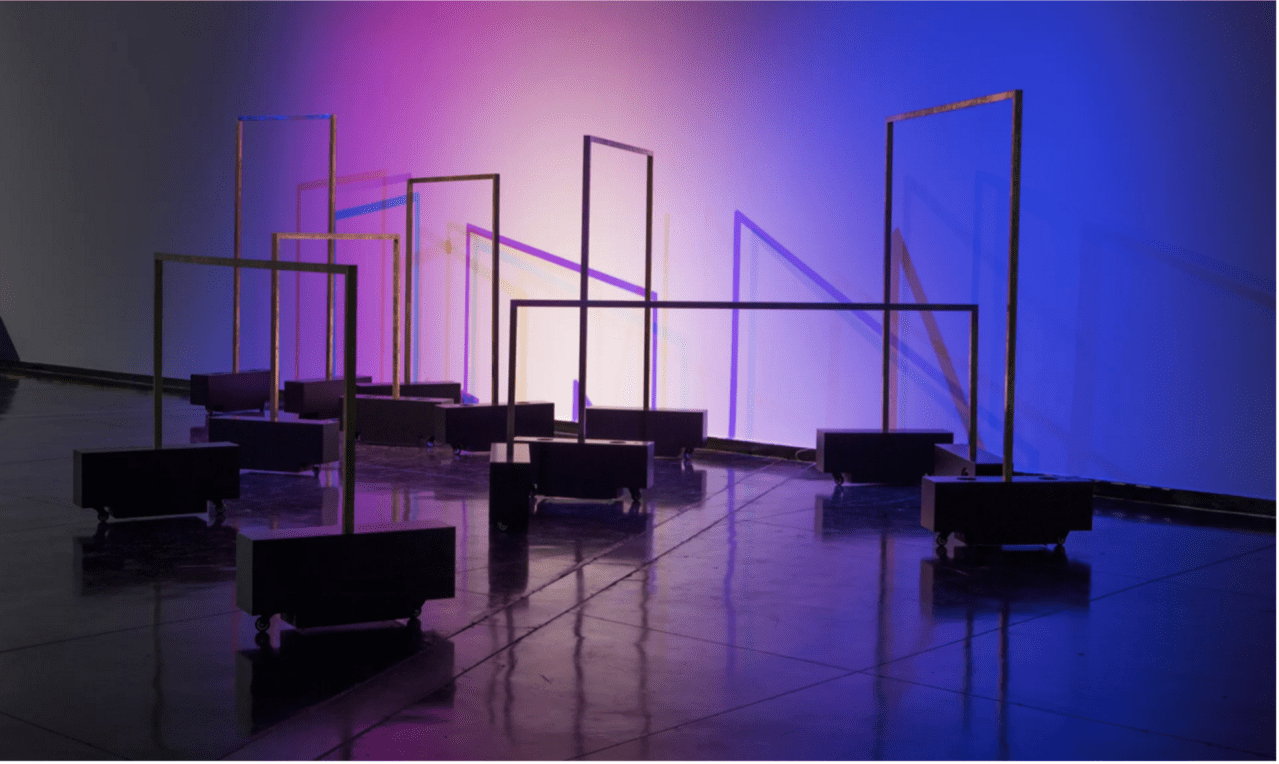
Anna Varendorff with Haima Marriott | here there are infinite arrangements NEW 16 at Australian Centre for Contemporary Art | Melbourne, Australia
5 March – 8 May 2016
Curated by Annika Kristensen, NEW16 at the Australian Centre for Contemporary Art showcases the recently commissioned works of eight emerging Australian artists: Jacobus Capone, Catherine or Kate, Julian Day, Gabriella Hirst, Tanya Lee, Mason Kimber, Liam O’Brien and Anna Varendorff with Haima Marriott. Working across various media (with a certain emphasis on sound and video), the artists reveal an overarching interest in the artistic process, human connectedness and the construction of space. One work that particularly speaks to all of these themes, is here there are infinite arrangements by Anna Varendorff with Haima Marriott.
here there are infinite arrangements is a flexible, sculptural-acoustic landscape that provides audiences with a rare opportunity to explore sonic, spatial and social relationships. Seven rectangular black-and-brass frames are gathered in a cluster. Two vertical posts are connected at the top by one horizontal bar to form each apparatus. All differ in height and width. Although seemingly positioned at random, the installation is neat, minimal, sophisticated. here there are infinite arrangements appears as a kind of chic jungle gym – an invitation to play.
The seven frames are set atop wheels (which at a closer glance appear to support the speakers from which the sound emanates). As the participants compose their own Dada-like overture, a new sculptural composition is simultaneously orchestrated as the apparatus are reassembled into new groupings. Linear shadows bathed in kaleidoscopic light creep across the wall and floor; growing and shrinking–appearing and dissolving. Visitors are momentarily removed from the constraints of reality and transported to an unfamiliar space of free play. The gallery is enlivened as a place for curiosity, experimentation and collaboration as the traditional relationships between art object and audience are blurred.
While participants quickly learn how to activate the music, the sound heard remains ultimately detached from its original source. This renders the apparatus a type of acousmatique instrument, free to be played by all who encounter it. By veiling the source of the sound, Varendorff and Marriott invite participants to carefully consider how spatial and sonic arrangements are consequent to physical interaction. In this scenario, sound shifts from a mysterious diversion to a key instrument in the construction of the interactive narrative. Here, the participant takes agency and temporarily becomes the producer.
Although certain viewers remained hesitant to touch the work (let alone reconfigure it), here there are infinite arrangements does not seek to intimidate. The non-linear and abstract nature of the sounds and sculptures means that there is no ‘wrong’ composition. Control is surrendered as the artists embrace the unknown, generously offering co-authorship to the audience/participants. here there are infinite arrangements is a collaborative work in constant flux, definitive resolve and resist a singular hand to determine its outcome. Each movement subsequently affects the experience of the surrounding artworks in ACCA’s New16. For some viewers, this might enhance the moment, for others it may disrupt it.
As children we are constantly encouraged to engage in play as a means to develop cooperation, creativity and confidence (these are just a few of many proven social and cognitive benefits). Play can also be relaxing, not to mention fun. So why do we not make more time for it as adults?
By merging art and play, sculpture and sound, audience and artwork, Varendorff and Marriott encourage us to reconsider a myriad of relationships, both within and outside the gallery walls. Not just a treat for the senses, the work offers a contemplative space in which to freely explore unknown possibilities. here there are infinite arrangements is a refreshing reminder of the benefits of simply losing one’s self in play.
This article was originally published by Art Kollectiv in March 2016.
 hayley-haynes.com