
FROOSH, FWASH, SLOOSH, WHUPP!

Christian Marclay | White Cube (Bermondsey), London
28 January – 12 April 2015

White Cube’s major solo exhibition of works by Christian Marclay is a comprehensive exploration of the relationship between text, sound, image and performance. The exhibition presents video installations alongside works on paper and canvas, complemented by a series of Fluxus-inspired Happenings. With references to Pop Art, Action Painting and the history of Performance Art the exhibition is a celebration of Post-War artistic achievements, which are re-imagined for contemporary audiences.

Upon entering the gallery, one is immediately drawn into the darkness of ‘Surround Sounds’ (2014), a silent cacophony of onomatopoeic comic strip cuttings. The installation comprises of four large synchronised screens projecting a series of animated words collated from Superhero narratives. The sound does not come from an audio track, rather from this lexicon of Klangs, Ktangs, and Kliks that blur across the screens, transporting the viewer into a loud world of action. Whoooosh, Zoooom, Whrrrr, the playful use of language is exciting. Each word is brought to life, not only by its onomatopoeic quality, but also through Marclay’s adoption of basic design and animation principals: composition, size, shape, colour, speed, and direction. A small tic, creeps around the bottom of the screens, tic.. tic.. tic.. building tension and increasing in pace; tic, tic, tic, tic.. until BANG! A heavy THOOM suddenly thuds from the ceiling to the floor. The screen is soon attacked with Beep! Beep! Beeps flashing manically. Collaged cuttings are choreographed to create a dizzying frenzy in this sonic adventure.

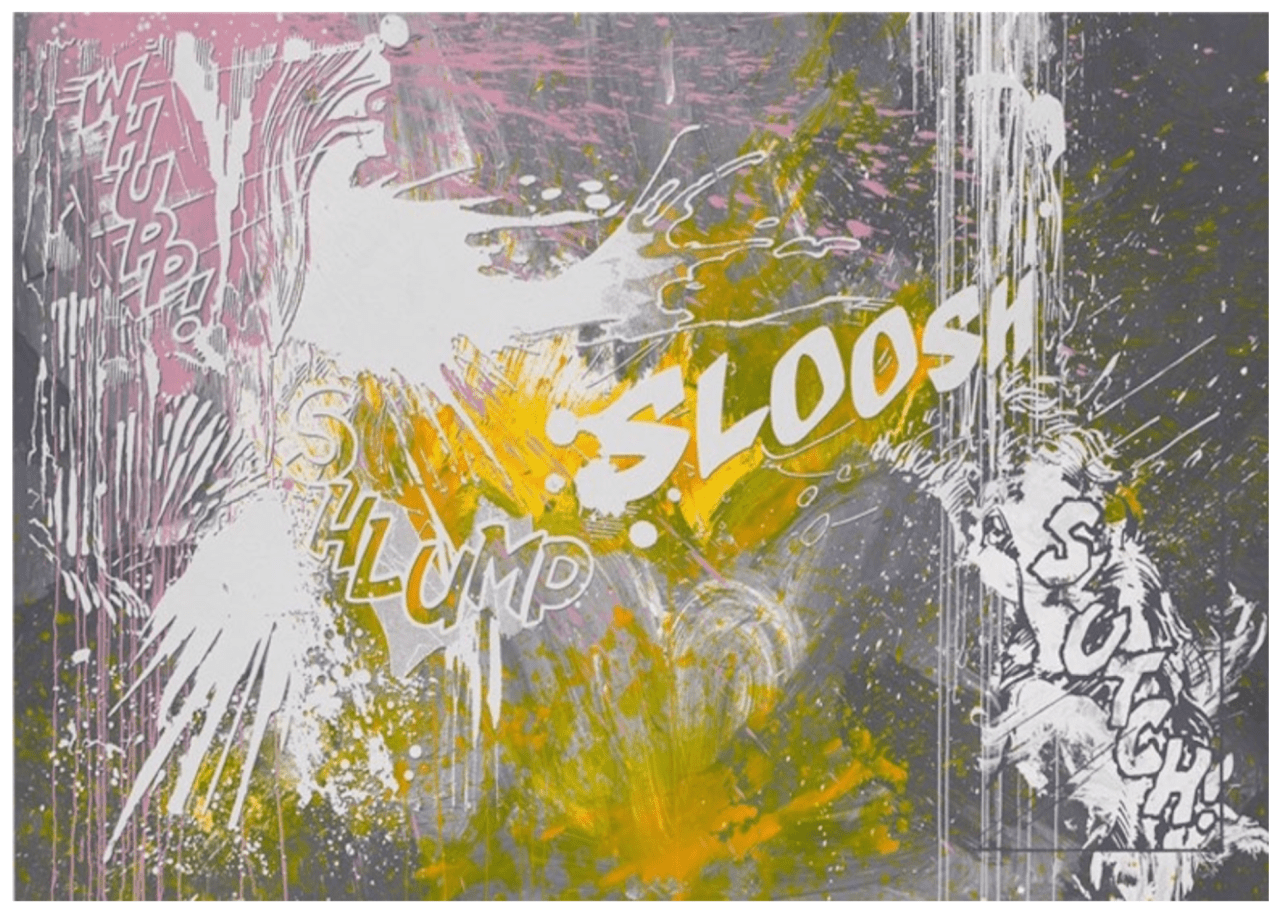
The exhibition of Marclay’s paintings proved a fitting accompaniment to ‘Surround Sounds’ with their continued use of Pop imagery. They also provided an interesting segueway into the examination of Action and Performance. The works on paper and canvas bring together the two very distinct movements of Pop Art and Action Painting, both of which appeared during the 1950s in America yet remained very separate. The friction between the democracy of Pop Art and the elite nature of Abstract Expressionism, in this case, Action Painting, is negotiated by the artist’s union of the two forms.

Snippets of Pop text are printed over performative splatters of paint. Plop, Glop, Splish, Slup. These “wet” words, once again demonstrate the artists’ fascination with sound mimesis whilst also alluding to the liquid quality of the paint that is poured, dripped and splattered across the surface of the works. Here Marclay uses the text of Pop Art to evoke the gesture of Action Painting. Action plus

the sound of the action are ironically brought together to produce a silent, static, object. Does Marclay’s merging of the two conflicting movements render the popular, elite – or is the elite rendered popular? The traditional hierarchy is negated.

In 1958 art critic Harold Rosenberg defined Action Painting by its capacity to transform the canvas into “an arena in which to act.” He explained, “what was to go on the canvas was not a picture but an event.” As a result, Action Painting is seen by many as the forbearer to the Fluxus movement, Happenings and the birth of Performance Art. Marclay’s video and performance works such as ‘Pub Crawl’ (2014) thus mark another logical development in his exploration of the everyday and the performative.

‘Pub Crawl’ is a participatory performance. The installation features a series of eleven video projections that trace the artist’s journey through the desolate streets of East London, early in the morning after. The tapping of empty bottles and cans produces an echoing soundtrack. This could be interpreted as a comment on contemporary drinking culture, or simply, a reinvigoration of everyday waste. With the presence of sound, the text of the former works is rendered redundant, and so abandoned. The videos are projected down either side of the main corridor walls. As the shadow of the viewer’s legs is cast onto the walls, one has no choice but to join the crawl. The passive viewer is unwittingly made the active subject.

The exhibition culminates in the North Gallery where a series of live Fluxus happenings have been scheduled for the duration of the exhibition, bringing together the investigation of text, sound, image and performance. The result is a unique sound recording on vinyl, presented in a limited edition cover printed with a sound-mimesis-meets-action image. Available to purchase for just £25, these Happenings render the rarified art object accessible to a wider public. Whoop, Wahh, Woo!
Gathering at the NGV

clinamen by Céleste Boursier-Mougenot
National Gallery of Victoria, International | Melbourne
3 May – 8 September 2013

Findings presented at the recent Museums Australia (MA) national conference in Canberra and the presence of Céleste Boursier-Mougenot’s clinamen at the National Gallery of Victoria (NGV) both underscore the growing role of the museum to function as a place of social interaction.

In her article ‘Six megatrends changing the arts’ (artsHub, 19/05/13), Deborah Stone discusses factors (as identified by CSIRO trend analyst Stefan Hajkowicz) that are expected to influence the way museums and galleries operate in the future. Her discussion is in response to Hajowicz’s presentation at the MA national conference last week. As everyday physical encounters continue to be replaced by the virtual, it is of no surprise that Hajkowicz’s highlights a rising desire for social experience. He suggests that such experience might be found, in lieu of the shopping mall (an increasingly redundant space of social interaction), at the museum.

As we know, the twenty-first century art museum is no longer a stark white cube where the predominant sound is that of heels clacking on the polished concrete, amongst the occasional whisper.  It is instead a dynamic space of endless activity. With many contemporary artists engaging with site specific, performance based works and relational aesthetics. it is difficult to predict what one might nowadays encounter at the gallery. Remember Bianca Hester’s Please leave these windows open overnight to enable the fans to draw in cool air during the early hours of the morning at the Australian Centre for Contemporary Art in 2010?

At the NGV however, one thing appears constant: a dedication to contemporary art that encourages social interaction.  In 2010 Harrell Fletchercollaborated with Melburnians at the NGV to produce The sound we make together (Melbourne), a hybrid of installation, participatory performances and presentations. Fletcher is perhaps best known for his web-based project with Miranda July, Learning to Love You More 2002-2009, that used the internet to re-engage participants with the outside community. Melbourne artist Jon Campbell gathered people at the gallery to create contemporary music and art in the collaborative work, Just sing what you feel (Dec 2012 – Feb 2013) and earlier this year, Rikrit Tiravanija invited visitors to dine in the gallery as part of Untitled (lunch box). Through the sharing of a meal, the public was encouraged to touch, taste and talk.

The NGV’s promotion of the gallery as a space of social interaction is also emphasised by the current installation of French artistCéleste Boursier-Mougenot’s clinamen. Whilst I am a sucker for anything French, it was Max Delany (Senior Curator, Contemporary Art, NGV) quoted in the media release who sparked my intrigue:  “With its seductive use of colour, sound and space, clinamen offers a multi-sensory synaesthetic experience, whilst also creating a social space for reflection and contemplation.”  What more could one ask for from a piece of art?

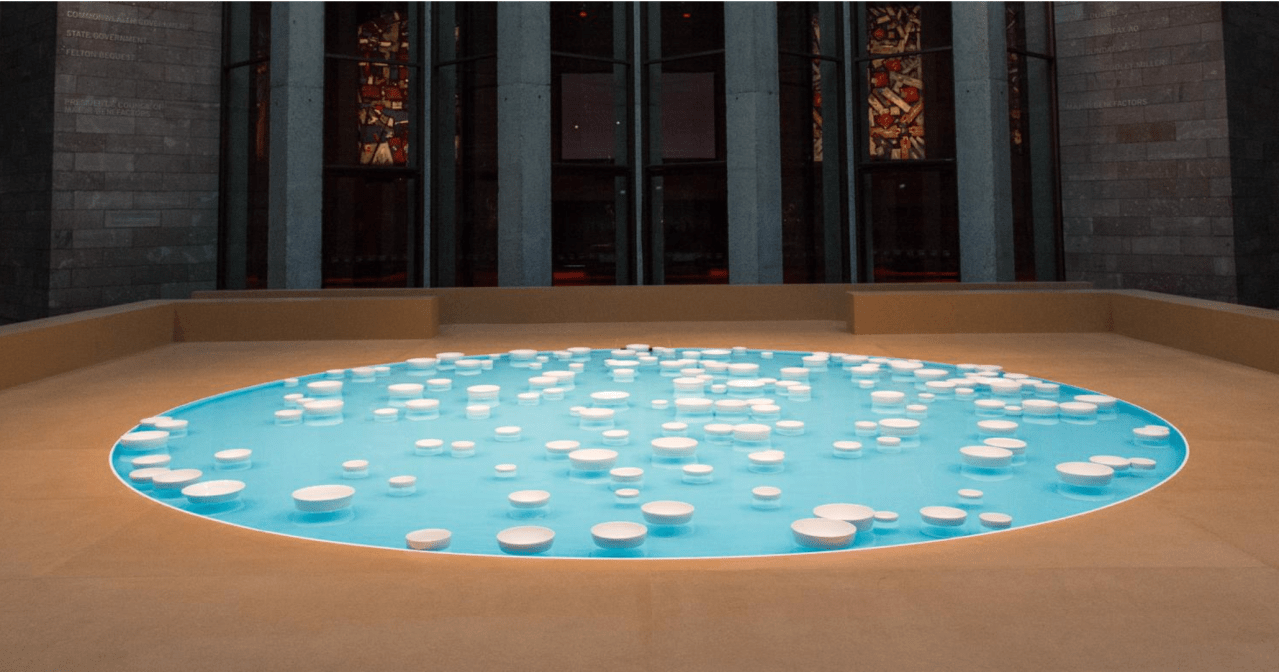
Ceramic white bowls of various sizes float in a large round pool, drifting in no particular direction upon the bright blue surface.  At times they converge, to produce pristine tones like that of a glockenspiel. Then they disperse, each following an unknown path. The energy of the piece is fluctuating and the sounds are variable. Clusters of vessels gently form to produce soft rings as though in conversation. It is calming to close your eyes and listen to the melody of the bowls, but observing the patterns created is as equally entrancing. clinamen is at once an aural and visual delight.

Situated in Federation Court on the ground level of the NGV, people naturally gravitate towards the subtle chimes of the luminescent pond upon entry. MDF seating is constructed around the pool, allowing space for congregation, and comfort for extended contemplation.  It acts as a public square. Not only a place of social gathering but one of communal reflection. Whilst I initially imagined myself to be alone with this work, in some hidden wing of the gallery, I soon learned that its centrality was essential. There is something special about being around people who are as equally enthralled in a piece of art as ones self – or perhaps it is simply being around people…

Sophisticated in its simplicity, and all encompassing in its sensory effect, I hope to encounter more of Boursier-Mougenot’s work in Melbourne. clinamen is a contemporary companion to Monet’s Garden. Though more than a supporting act, it is an event in itself.  Whilst clinamen is an ultimately introspective work, its power lay in its subtle ability to gather people, creating a unique and shared moment amongst otherwise strangers. This is the type of experience that we increasingly desire according to Hajkowicz. Boursier-Mougenot and the NGV demonstrate the growing agenda of the museum as a space of social gathering, facilitating meaningful connections in an alienating society.