In the Beginning | Ramesh Mario Nithiyendran


Curated by Jaqueline Doughty
Ian Potter Museum of Art | Melbourne, Australia

22 Nov 2016 – 26 Feb 2017

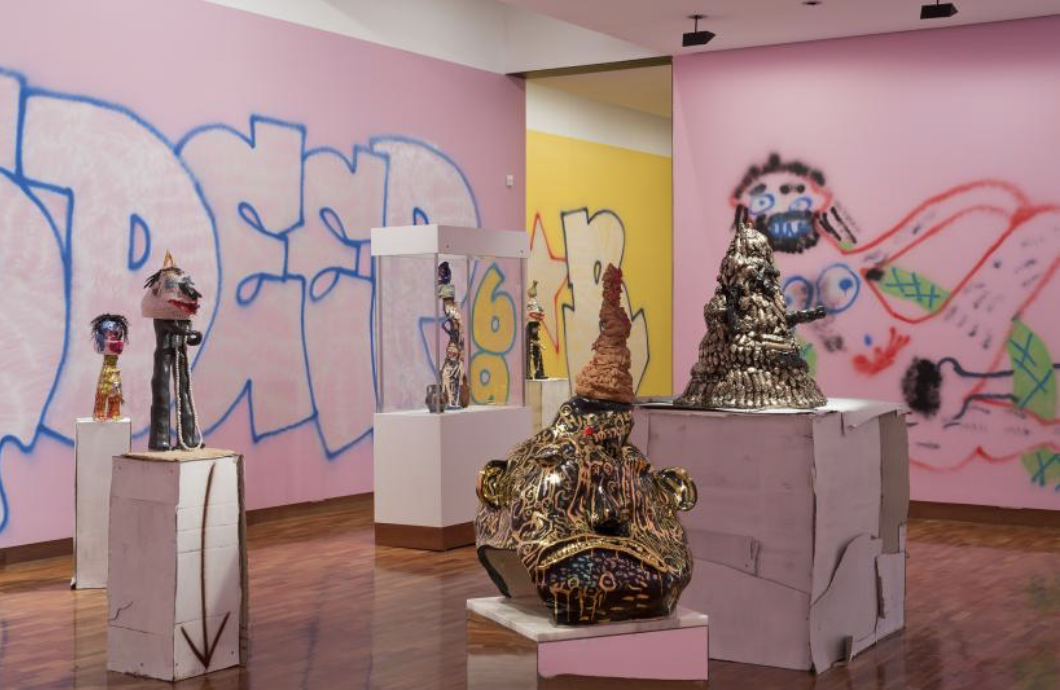
It is without question that ceramics are trending high in the contemporary art world. From the witty urns of Grayson Perry, and the evergreen vessels of Betty Woodman to the Modernist interventions of Sanné Mestrom, some of the most exciting exhibitions of 2016 have turned the spotlight towards the malleability of the medium.

Enter Ramesh Mario Nithiyendran.

See full article at this is tomorrow Contemporary Art Magazine, here
Published 26 January, 2017

[Image : Ramesh Mario Nithiyendran: In the Beginning, installation view at Ian Potter Museum of Art, 2016 / Credit : Photo by Christian Capurro]

THENABOUTS | Philippe Parreno

ACMI | Melbourne, Australia
6 Dec 2016 – 13 Mar 2017

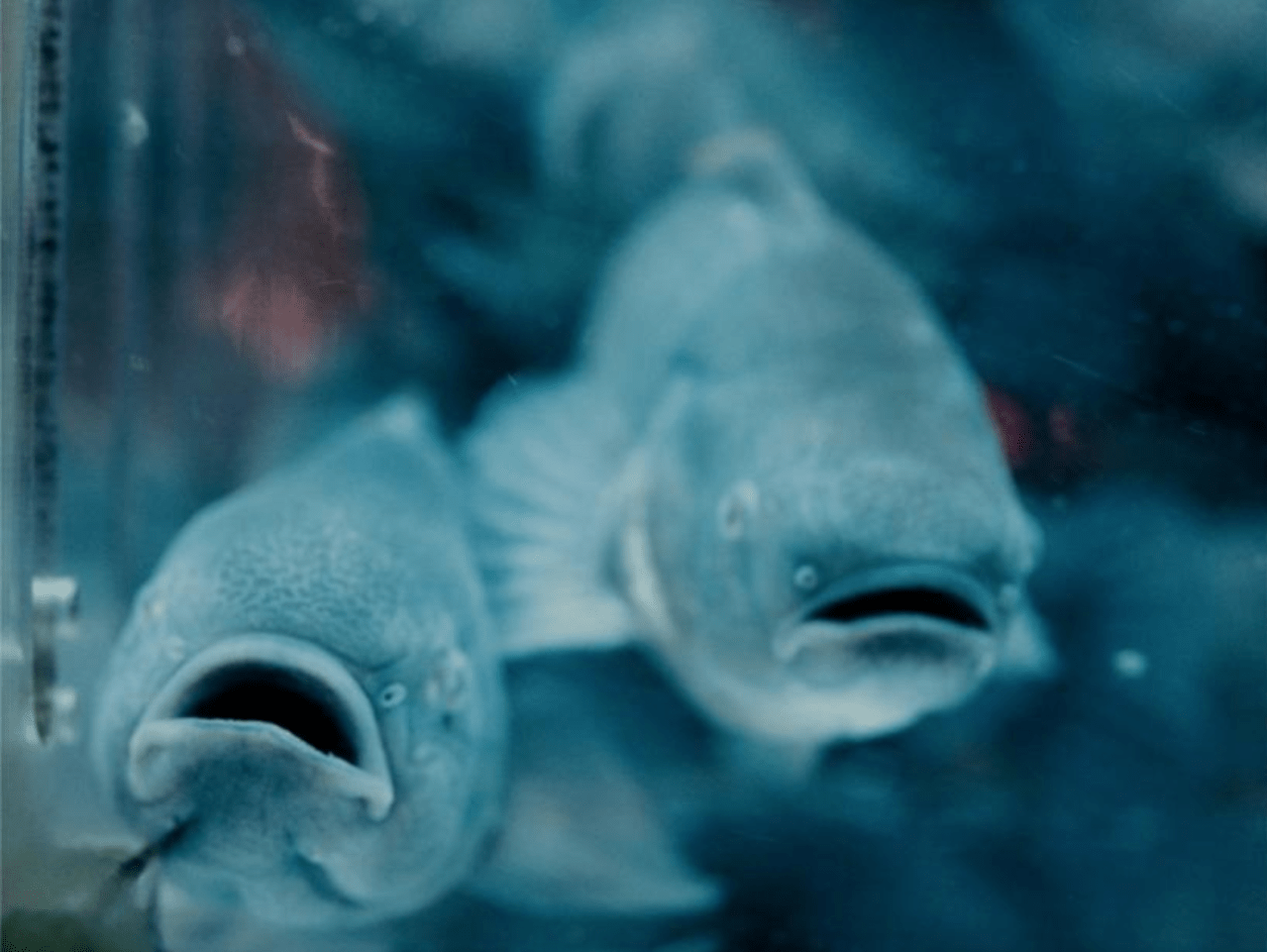
In the darkened subterranean gallery of ACMI, The Projectionist draws the theatre curtains. Adjusting the width of the screen, the gesture is both performative and practical. The Projectionist announces the upcoming film and proceeds to press play.

The séance begins.

See full article at this is tomorrow Contemporary Art Magazine, here.
Published 16 December, 2016

[Image: Philippe Parreno, Invisible Boy, 2010 (film still) (c) Philippe Parreno]

Sanné Mestrom’s Leftovers

RMIT Project Space | Melbourne, Australia
8 April – 12 May 2016

A perfect circle of glass, once belonging to Stephanie Shield, is wedged into an imperfect ceramic lump; the smooth edge of the glass forcing rough cracks through the clay. A touch of terracotta seeps out of Mira Gojak’s unwanted copper pipe, subtle, but enough. The gentle fluidity of Elizabeth Newman’s rainbow shower mat, opposes the solidity of the stark ceramic form atop which it is draped. Contrasting materials converse in Sanné Mestrom’s series of unexpected sculptural encounters.

Mestrom’s ceramic sculptures directly respond to, and incorporate, the discarded scraps of “more established” artists. In her solo exhibition Leftovers at RMIT’s Project Space in Melbourne, Mestrom reimagines each remnant through a series of formal yet playful ceramic interventions. The once superfluous offcuts are reassigned worth, elevated to the status of contemporary art. Trash becomes treasure in this autobiographical exploration of both material and personal relationships.

Mestrom’s ongoing concern for the formal is evident; shape, line, form, mass, balance and texture are all considered. The potentials of positive and negative space are also closely explored. The banal is transformed into a series of unique abstract arrangements that address the artist’s modernist concerns for material, process and technique. The resulting sculptures, dictated by chance, are minimal, sophisticated and sincere.

Whilst the artist had little control over the materials that she would receive for this project, each sculpture is the manifestation of a series of conscious decisions that began long before the “found” objects reached her studio. Despite the initial air of abandonment to each object donated, there was also a process of selection involved, a reinstatement of recognised potential, that particularly inspired Mestrom: “These weren’t just any old scraps, they were cast out in the course of another artist’s own careful editing process. Each rejected remnant was immediately imbued with new value simply by being selected – picked up off the floor and handed over as ‘something’. The artistic process thus stretches far beyond the physical manipulation of the ceramic intervention. It began with a string of humble letters.

These letters are presented in a smaller adjoining space where they offer further insight into the provenance of the exhibition, and the personal life of the artist. Viewers are invited to sift through polite exchanges between Mestrom and gallery assistants, curators and directors – and if she was lucky, her artistic peers and role models themselves. Each of the artists contacted has profoundly influenced Mestrom’s practice today. For those obliging to participate, these personal narratives of generosity breathe warm life into the resulting sculptures. This is emphasised by the title of the works (ie. ‘Dear Lizzy’ (Elizabeth Newman) ). Each sculpture becomes a love letter. Recalling the relational works of Sophie Calle, the letters demonstrate the vulnerability of the artist that is central to this project. By displaying this documentation the exhibition is shifted from an objective exploration of materiality, to an intimate self portrait of the artist.

The series of exchanges also reveal the business side of the art world and associated hierarchies. Amongst those “artistic-heroes” contacted to no avail were international bigwigs, Martin Creed, Isa Genzken, Barbara Kruger and Roni Horn. As such, notions of value are addressed not only by the transformation of the received remnants, but also by the absence of those unattainable – which if present, would further raise complex questions about appropriation and the global art market.

Sanné Mestrom often describes her work as “art about art”. Leftovers is that. But it is also more. I am grateful to the artist for sharing a rare glimpse into the personal side of her practice. Whilst her work is as visually and conceptually strong as ever, it was comforting to be reminded that we are not alone in feeling at times intimidated, rejected, or insignificant. And it is these moments that make the support that we do receive, all the more valuable – and most certainly worthy of being proudly presented atop a shiny black pedestal. For after all, it is sometimes the leftovers that are the best bit.

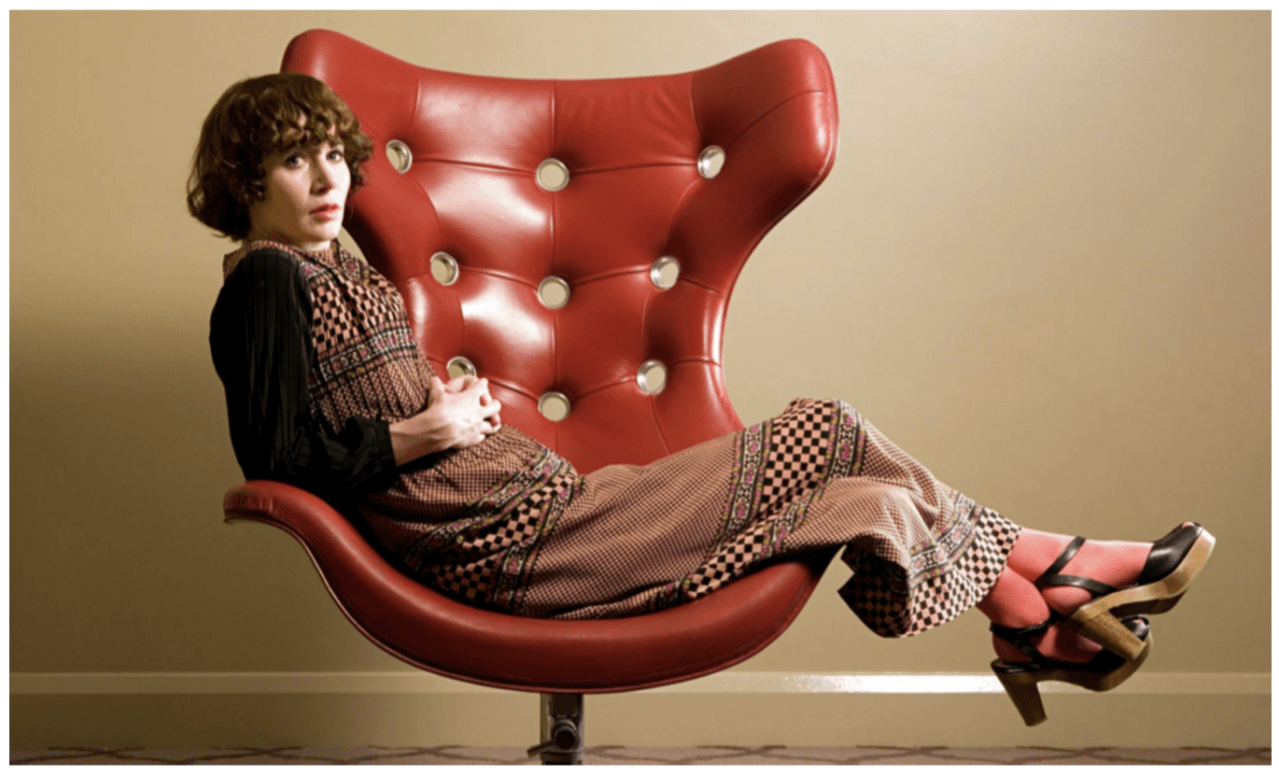
SURVIVING DISCOMFORT with Miranda July

Reflections on an evening in Melbourne with Miranda July

Miranda July | Lost Child!
Melbourne Town Hall | Melbourne, Australia 7 March 2016

Surviving Discomfort. That could have been the tagline for her presentation, ‘Lost Child’, Miranda July told us after she accidentally projected her email inbox in front of a full house of excited admirers at The Melbourne Town Hall on Monday night. The super startist immediately humanised herself. “Close your eyes. No seriously” she awkwardly urged us. It could not have been a more fitting opening to the evening. It was funny, uncomfortable, and real.

What was ‘Lost Child’ anyway? Many of us didn’t even know. It was simply enough that Miranda would be there. Miranda July feels like a friend, and so it is on a first name basis that she will be addressed. We soon learnt that ‘Lost Child’ refers to the title of the first ever book written by Miranda at the age of just 7. She was generous enough to share a few pages of her endearing first ever written work with us. From the short snippet, it was evident that she was a child destined for a bright and quirky future. Throughout the evening that took shape as an autobiographical talk, the audience was offered an intimate insight into this artistic journey and the staggering mind of the artist, delivered via some of her lesser-known works.

Miranda is an artist. I use this term in the loosest way possible, for in fact, Miranda defies the limits of categorisation. Artist, performer, writer, dancer, actor, producer, director… Like most stubbornly independent souls, she refuses to be defined by just one label. She admitted her hesitation to embark on another film after the success of her directorial debut Me and You and Everyone We Know (2005) due to a fear of being categorised as an Indie Filmmaker. As such, she didn’t release a film for another 6 years.

The images, footage and stories selected by Miranda for which to share her early years with us throughout the evening were inconveniently interrupted. A series of slides that revealed a list of banal day jobs worked by the artist to support herself flashed across the screen. Cashier. Cashier. Stripper. Car door unlocker for Pop-a-Lock. These boring black-text-on-white-background slides were supposed to be inconvenient because for a young artist trying to shape her place in the world, these jobs were inconvenient. (The insights offered by the slides remained however fascinating and somewhat entertaining). We were reminded again that Miranda is real. And so was her struggle. Did I mention she was a chronic shoplifter?

Realness came to embody much of the artist’s work that features everyday people and everyday moments. For real art, to Miranda, was not that which existed in galleries and museums, but belonged to everyday moments that occurred in the real world. Together with Harrell Fletcher, Miranda decided that it was the role of the artist to point out these moments. And thus, as many were still learning what www stood for, Learning To Love You More (2002-2009) was borne. This participatory project used the Internet to facilitate everyday creative experiences, inviting audiences around the world to perform and share their assignments (set by Miranda and Fletcher) with one another. Ironically the project was later acquired by the San Francisco Museum Of Modern Art, however it remains accessible online as an archive.

Miranda’s interest in using technology to engage strangers with the outer world through performance was more recently demonstrated by the development of the iOS message delivery application Somebody (2014). When using the app, instead of your message being sent directly to your friend, it would be sent to a nearby Somebody user (most likely a stranger) who would in turn physically deliver/perform that message to the designated recipient.

Miranda’s interest in encounters with strangers and the discomfort this often brings, alongside her belief in a democratic art, has informed much of her work. Amateur strangers have played a central role in many of her productions. From Richard her shoe repair man who featured in a questionable early short film, to a young removalist in LA whose audition tape we were privileged to view, and let’s not forget Joe, an elderly kindred spirit found in the Pennysaver who is featured in the book It Chooses You (2011) and stars in The Future (2011). He plays the Moon. The willingness of strangers to engage in Miranda’s projects, just as we the audience participated in several interactions orchestrated on the evening, demonstrates the artist’s ability to gain our trust. It also suggests our own desire to be a part of something, to feel connected. In a world in which strangers grow increasingly suspicious of one another, we trust Miranda because she is honest, warm and humble. She welcomes us into her world with open arms and thus we feel like old friends.

‘Lost Child’ confirmed what we all already knew about Miranda July. That she is brilliant. More than that, it reminded us that she is real and that her life is just as full of uncertainties as the rest of ours. It is in these moments that we are lucky to have a friend like Miranda to whom we can turn. Her awkward humour, quirky wit and endearing openness help shed light on the art in all of our lives. This is both comforting and inspiring. In ‘Lost Child’, as across her practice, Miranda Jennifer July generously shares her experiences of uncertainty and discomfort, so that we can better survive our own. (She even shared her middle name with us. Yes, Jennifer. And no, she is not thrilled by it. That is real.)

This article was originally published by Art Kollectiv in March 2016.

SOUNDS LIKE FUN at New 16

Anna Varendorff with Haima Marriott | here there are infinite arrangements NEW 16 at Australian Centre for Contemporary Art | Melbourne, Australia
5 March – 8 May 2016

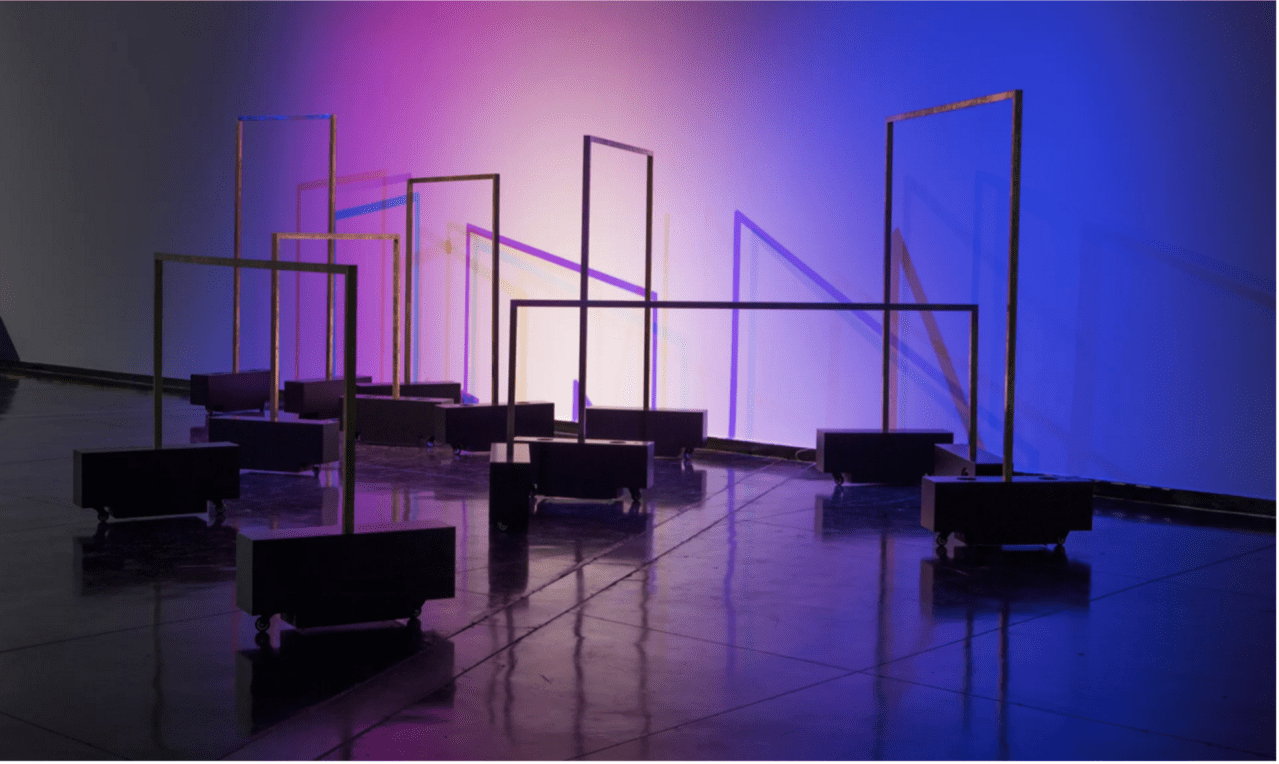
Curated by Annika Kristensen, NEW16 at the Australian Centre for Contemporary Art showcases the recently commissioned works of eight emerging Australian artists: Jacobus Capone, Catherine or Kate, Julian Day, Gabriella Hirst, Tanya Lee, Mason Kimber, Liam O’Brien and Anna Varendorff with Haima Marriott. Working across various media (with a certain emphasis on sound and video), the artists reveal an overarching interest in the artistic process, human connectedness and the construction of space. One work that particularly speaks to all of these themes, is here there are infinite arrangements by Anna Varendorff with Haima Marriott.

here there are infinite arrangements is a flexible, sculptural-acoustic landscape that provides audiences with a rare opportunity to explore sonic, spatial and social relationships. Seven rectangular black-and-brass frames are gathered in a cluster. Two vertical posts are connected at the top by one horizontal bar to form each apparatus. All differ in height and width. Although seemingly positioned at random, the installation is neat, minimal, sophisticated. here there are infinite arrangements appears as a kind of chic jungle gym – an invitation to play.

The seven frames are set atop wheels (which at a closer glance appear to support the speakers from which the sound emanates). As the participants compose their own Dada-like overture, a new sculptural composition is simultaneously orchestrated as the apparatus are reassembled into new groupings. Linear shadows bathed in kaleidoscopic light creep across the wall and floor; growing and shrinking–appearing and dissolving. Visitors are momentarily removed from the constraints of reality and transported to an unfamiliar space of free play. The gallery is enlivened as a place for curiosity, experimentation and collaboration as the traditional relationships between art object and audience are blurred.

While participants quickly learn how to activate the music, the sound heard remains ultimately detached from its original source. This renders the apparatus a type of acousmatique instrument, free to be played by all who encounter it. By veiling the source of the sound, Varendorff and Marriott invite participants to carefully consider how spatial and sonic arrangements are consequent to physical interaction. In this scenario, sound shifts from a mysterious diversion to a key instrument in the construction of the interactive narrative. Here, the participant takes agency and temporarily becomes the producer.

Although certain viewers remained hesitant to touch the work (let alone reconfigure it), here there are infinite arrangements does not seek to intimidate. The non-linear and abstract nature of the sounds and sculptures means that there is no ‘wrong’ composition. Control is surrendered as the artists embrace the unknown, generously offering co-authorship to the audience/participants. here there are infinite arrangements is a collaborative work in constant flux, definitive resolve and resist a singular hand to determine its outcome. Each movement subsequently affects the experience of the surrounding artworks in ACCA’s New16. For some viewers, this might enhance the moment, for others it may disrupt it.

As children we are constantly encouraged to engage in play as a means to develop cooperation, creativity and confidence (these are just a few of many proven social and cognitive benefits). Play can also be relaxing, not to mention fun. So why do we not make more time for it as adults?

By merging art and play, sculpture and sound, audience and artwork, Varendorff and Marriott encourage us to reconsider a myriad of relationships, both within and outside the gallery walls. Not just a treat for the senses, the work offers a contemplative space in which to freely explore unknown possibilities. here there are infinite arrangements is a refreshing reminder of the benefits of simply losing one’s self in play.

This article was originally published by Art Kollectiv in March 2016.
Gathering at the NGV

clinamen by Céleste Boursier-Mougenot
National Gallery of Victoria, International | Melbourne
3 May – 8 September 2013

Findings presented at the recent Museums Australia (MA) national conference in Canberra and the presence of Céleste Boursier-Mougenot’s clinamen at the National Gallery of Victoria (NGV) both underscore the growing role of the museum to function as a place of social interaction.

In her article ‘Six megatrends changing the arts’ (artsHub, 19/05/13), Deborah Stone discusses factors (as identified by CSIRO trend analyst Stefan Hajkowicz) that are expected to influence the way museums and galleries operate in the future. Her discussion is in response to Hajowicz’s presentation at the MA national conference last week. As everyday physical encounters continue to be replaced by the virtual, it is of no surprise that Hajkowicz’s highlights a rising desire for social experience. He suggests that such experience might be found, in lieu of the shopping mall (an increasingly redundant space of social interaction), at the museum.

As we know, the twenty-first century art museum is no longer a stark white cube where the predominant sound is that of heels clacking on the polished concrete, amongst the occasional whisper.  It is instead a dynamic space of endless activity. With many contemporary artists engaging with site specific, performance based works and relational aesthetics. it is difficult to predict what one might nowadays encounter at the gallery. Remember Bianca Hester’s Please leave these windows open overnight to enable the fans to draw in cool air during the early hours of the morning at the Australian Centre for Contemporary Art in 2010?

At the NGV however, one thing appears constant: a dedication to contemporary art that encourages social interaction.  In 2010 Harrell Fletchercollaborated with Melburnians at the NGV to produce The sound we make together (Melbourne), a hybrid of installation, participatory performances and presentations. Fletcher is perhaps best known for his web-based project with Miranda July, Learning to Love You More 2002-2009, that used the internet to re-engage participants with the outside community. Melbourne artist Jon Campbell gathered people at the gallery to create contemporary music and art in the collaborative work, Just sing what you feel (Dec 2012 – Feb 2013) and earlier this year, Rikrit Tiravanija invited visitors to dine in the gallery as part of Untitled (lunch box). Through the sharing of a meal, the public was encouraged to touch, taste and talk.

The NGV’s promotion of the gallery as a space of social interaction is also emphasised by the current installation of French artistCéleste Boursier-Mougenot’s clinamen. Whilst I am a sucker for anything French, it was Max Delany (Senior Curator, Contemporary Art, NGV) quoted in the media release who sparked my intrigue:  “With its seductive use of colour, sound and space, clinamen offers a multi-sensory synaesthetic experience, whilst also creating a social space for reflection and contemplation.”  What more could one ask for from a piece of art?

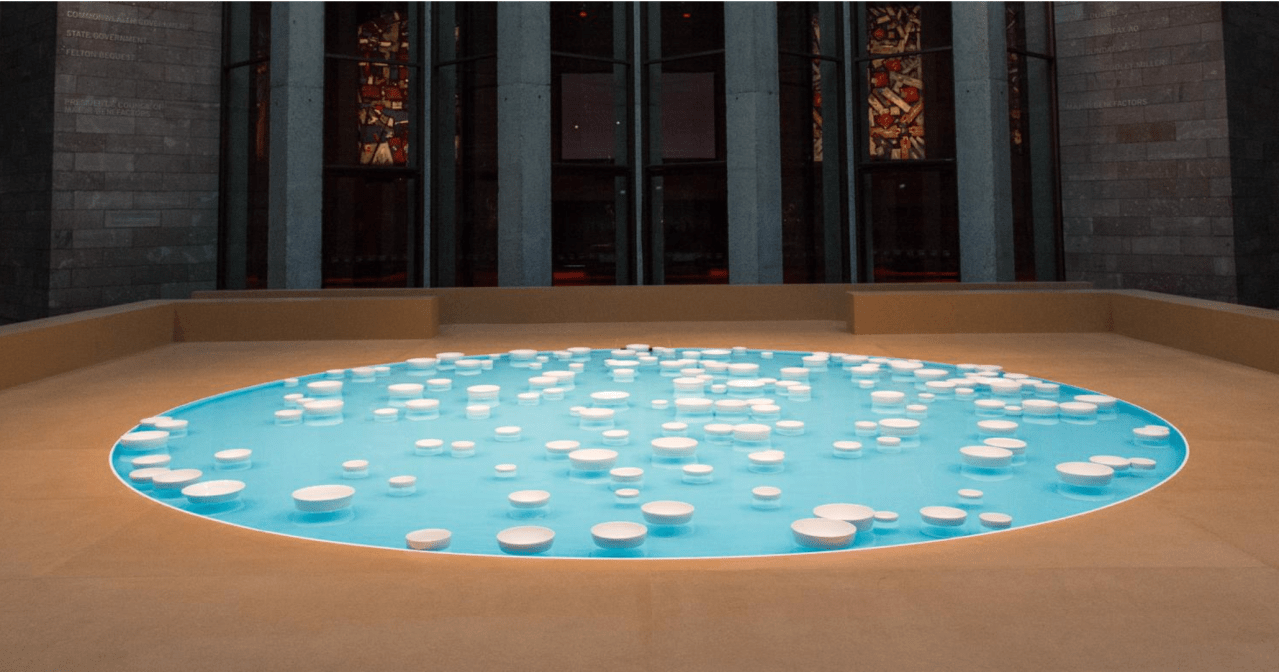
Ceramic white bowls of various sizes float in a large round pool, drifting in no particular direction upon the bright blue surface.  At times they converge, to produce pristine tones like that of a glockenspiel. Then they disperse, each following an unknown path. The energy of the piece is fluctuating and the sounds are variable. Clusters of vessels gently form to produce soft rings as though in conversation. It is calming to close your eyes and listen to the melody of the bowls, but observing the patterns created is as equally entrancing. clinamen is at once an aural and visual delight.

Situated in Federation Court on the ground level of the NGV, people naturally gravitate towards the subtle chimes of the luminescent pond upon entry. MDF seating is constructed around the pool, allowing space for congregation, and comfort for extended contemplation.  It acts as a public square. Not only a place of social gathering but one of communal reflection. Whilst I initially imagined myself to be alone with this work, in some hidden wing of the gallery, I soon learned that its centrality was essential. There is something special about being around people who are as equally enthralled in a piece of art as ones self – or perhaps it is simply being around people…

Sophisticated in its simplicity, and all encompassing in its sensory effect, I hope to encounter more of Boursier-Mougenot’s work in Melbourne. clinamen is a contemporary companion to Monet’s Garden. Though more than a supporting act, it is an event in itself.  Whilst clinamen is an ultimately introspective work, its power lay in its subtle ability to gather people, creating a unique and shared moment amongst otherwise strangers. This is the type of experience that we increasingly desire according to Hajkowicz. Boursier-Mougenot and the NGV demonstrate the growing agenda of the museum as a space of social gathering, facilitating meaningful connections in an alienating society.